You step out under a bright blue sky. An hour later, the wind is whipping up dust, clouds have rolled in, and the first heavy drops are falling. Sound familiar?
Weather that turns this quickly can feel random, or like the forecast got it wrong. In reality, there is a clear science behind it. Here is why weather can change so fast, and what drives the shift.
Fast weather is not random weather
The atmosphere is never still. Warm and cold air masses are constantly pushing against each other. Wherever the boundary between them sharpens, conditions can flip within the hour: clear skies to storms, calm air to gusty winds, in the time it takes to run an errand.
The four forces behind fast weather
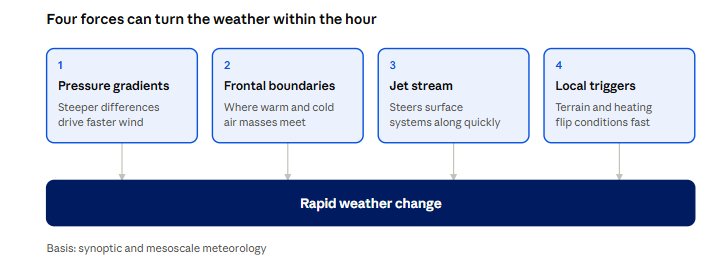
Rapid weather change is driven by four main forces, working on scales from whole continents down to a single valley:
- Pressure gradients: the steeper the difference in pressure between two places, the faster and stronger the wind.
- Frontal boundaries: where warm and cold air masses meet, weather changes sharply as the front passes.
- Jet stream steering: fast winds high in the atmosphere steer surface weather systems along quickly.
- Local triggers: hills, mountains and daytime heating can flip conditions in a single area within minutes.
The big misconception
A forecast can be accurate days ahead, and conditions can still shift within the hour. A sea-breeze front, a burst of daytime heating or a passing cold front can turn a stable atmosphere unstable in minutes. The forecast caught the pattern; the timing on the ground is simply quick.
What makes a change happen faster
Not every shift in the weather is sudden. These four ingredients decide how quickly things turn:
- Pressure gradient: steeper gradients drive faster, stronger winds.
- Temperature contrast: the sharper the contrast across a front, the faster it moves in.
- Moisture: more moisture in the air feeds faster storm growth.
- Wind shear: winds that change speed or direction with height can spin storms up quickly.
When several of these line up at once, a calm afternoon can become a storm in no time.
Where patterns collide
Forecasting predicts the pattern. Rapid change happens where patterns collide.
The atmosphere is a fluid in a constant balancing act. Wherever differences in pressure, temperature and moisture stack up in the same place, that balance breaks quickly, and that is when the weather turns on a dime.
Catching the shift before it reaches you
At WeatherWalay, we track these shifts before they reach your sky. Our multi-model forecast pipelines and live weather stations across Pakistan are built to catch fast-changing conditions early.